Why High-Quality Tool Steel Matters in Large Machinery Manufacturing
Behind every precision die, forging tool, and heavy industrial mold lies a material that determines how long the equipment will perform under demanding production conditions. While machining accuracy is important, the quality of the tool steel itself often has an even greater influence on durability, dimensional stability, and long-term operating reliability.
As manufacturing industries continue to increase production efficiency, the demand for premium tool steel has grown steadily across global markets.
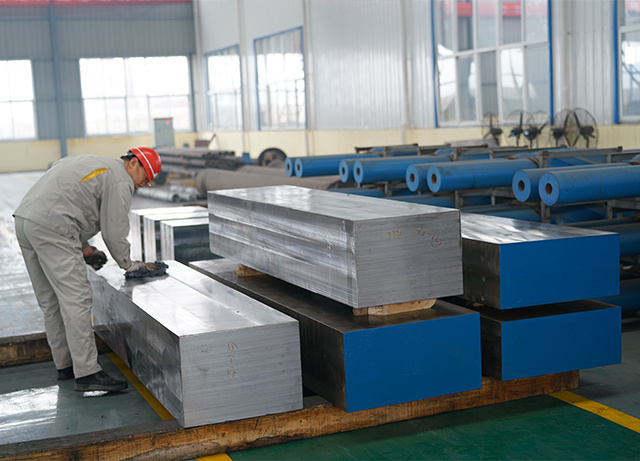
More Than Just a Steel Block
At first glance, a large tool steel block may appear to be nothing more than a piece of alloy steel awaiting machining.
In reality, every block represents the starting point of a high-value manufacturing process.
Whether it will eventually become a forging die, injection mold, extrusion tool, or heavy industrial component, its material quality directly affects machining performance, heat treatment behavior, and service life.
Selecting the appropriate steel grade at the beginning of a project often determines the overall success of the finished tooling.
Why Material Quality Comes First
Large tooling components operate under conditions that are far more demanding than ordinary structural parts.
Repeated thermal cycling, high mechanical loads, continuous impact, and severe wear place enormous demands on the material.
For these applications, tool steel must combine several critical properties:
High hardness after heat treatment
Excellent toughness against impact loading
Stable dimensions during machining
Strong wear resistance
Reliable fatigue performance
Achieving this balance requires not only carefully controlled alloy composition but also strict manufacturing processes throughout steel production.
Precision Preparation Before Machining
The quality of a large tool steel component is influenced long before CNC machining begins.
Surface preparation, block squareness, dimensional accuracy, and internal material integrity all contribute to the efficiency of later manufacturing stages.
Many customers today request pre-machined six-sided blocks, allowing mold manufacturers to reduce preparation time and move directly into precision machining.
This approach shortens production cycles while improving dimensional consistency throughout the manufacturing process.
For large molds and heavy industrial tooling, even small improvements in material preparation can result in significant savings in machining time.
Supporting a Wide Range of Industries
High-quality tool steel serves numerous industrial sectors where precision and durability are essential.
Typical applications include:
Forging dies
Plastic injection molds
Die casting molds
Heavy stamping tools
Industrial forming equipment
Large mechanical fixtures
Wear-resistant tooling components
Although the final products differ, they all rely on tool steel capable of maintaining stable performance throughout extended production cycles.
Manufacturing Capability Makes the Difference
As tooling becomes larger and more complex, customers increasingly evaluate suppliers based not only on material availability but also on processing capability.
Large-scale cutting equipment, precision milling, controlled heat treatment, and comprehensive quality inspection all contribute to delivering material that is ready for downstream manufacturing.
At Zhongyuan Heavy Forging, large tool steel blocks are processed with careful attention to dimensional accuracy, surface quality, and customer specifications. The company's manufacturing capability enables customized sizes and machining services for heavy industrial projects requiring reliable material performance.
By combining material expertise with precision processing, Zhongyuan Heavy Forging supports customers in reducing machining time while improving overall production efficiency.
Looking Toward the Future
Manufacturing technologies continue to evolve, but the demand for dependable tooling materials remains unchanged.
As equipment becomes larger and production environments become more demanding, high-performance tool steel will continue to play an important role in supporting industrial innovation.
For manufacturers seeking longer tool life, improved machining efficiency, and consistent product quality, choosing the right tool steel—and the right manufacturing partner—remains one of the most important decisions in the entire production process.